
PAM & Identity Security Buyer’s Guide

PAM & Identity Security Buyer’s Guide

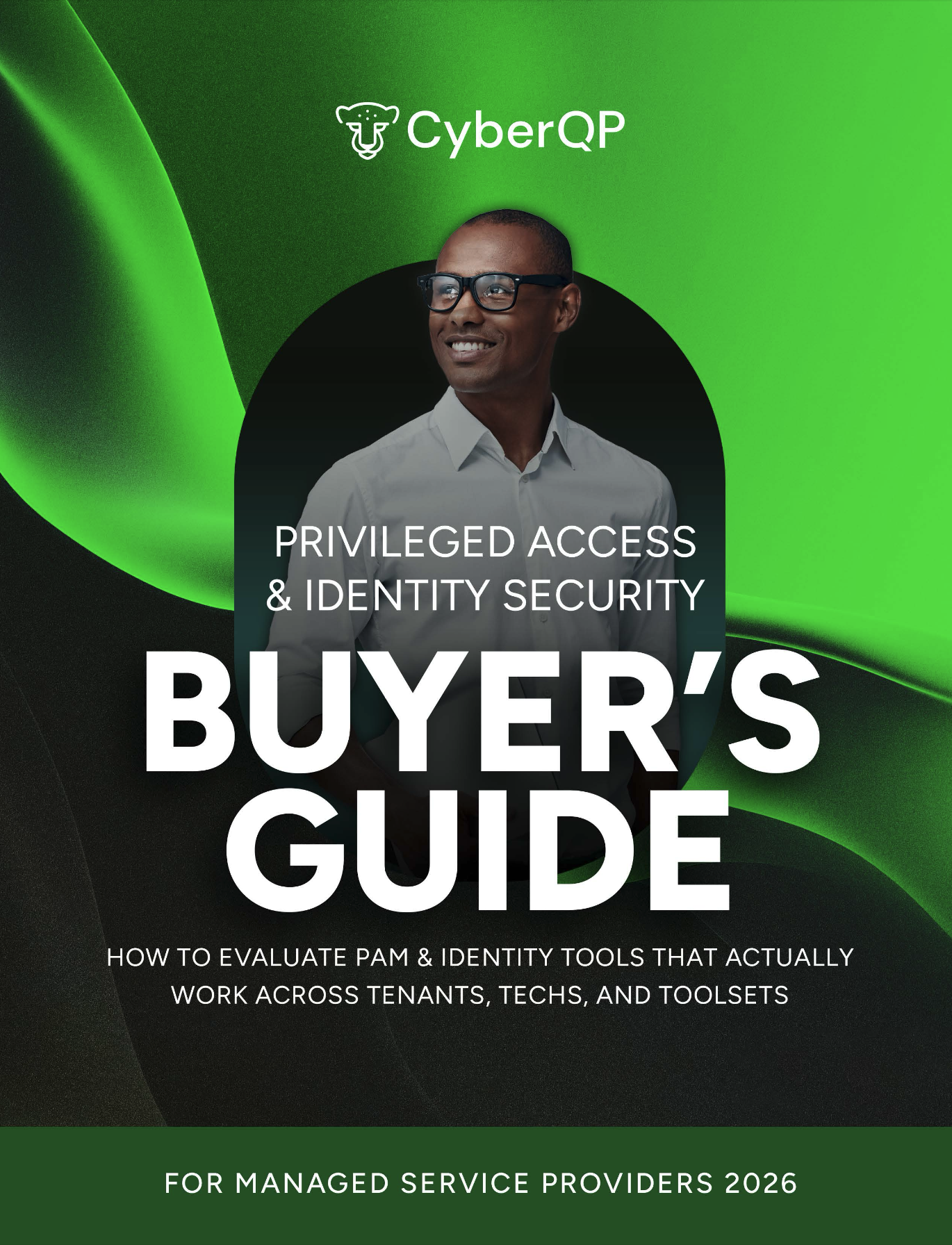
The Buyer’s Guide to Privileged Access & Identity Security

Most security demos are built to impress, not to work in real environments. This guide helps you evaluate privileged access and identity security tools based on real risk, real workflows, and the questions vendors hope you don’t ask. Use it to cut through the noise and choose a solution that actually reduces breach exposure across your helpdesk, endpoints, and users.

Access the Guide

    The Real Problem You’re Trying to Solve
    QGuard

    Achieving Zero Standing and Least Privilege

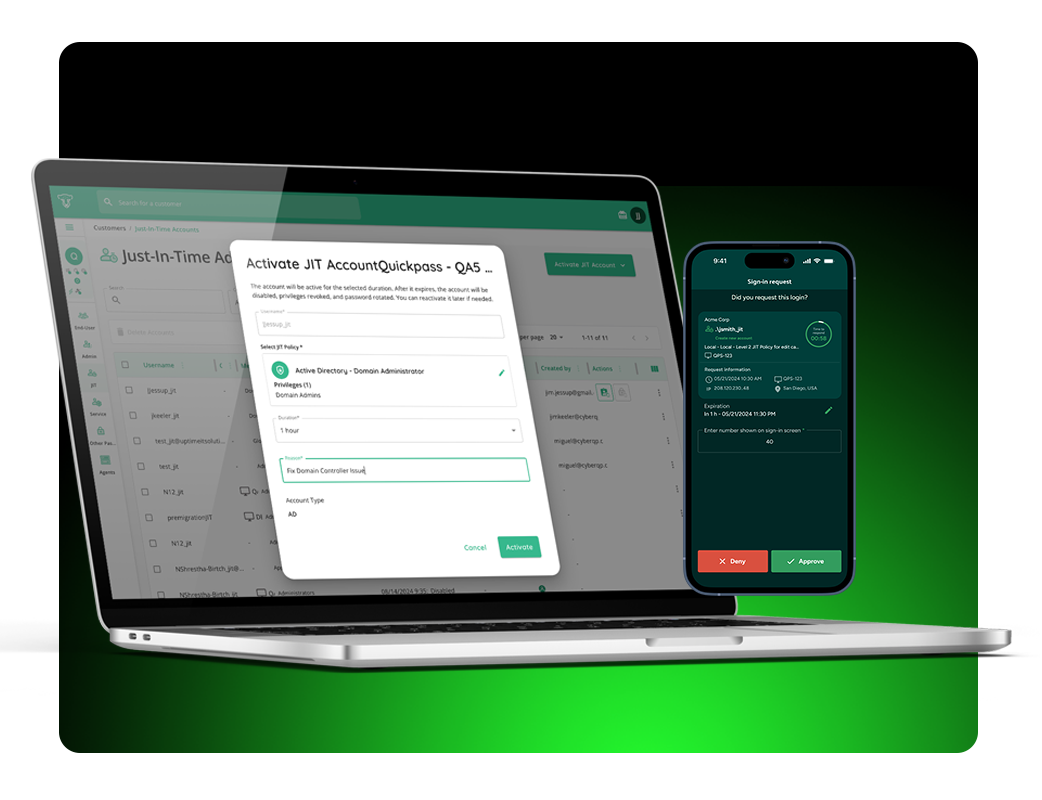
    Our PAM offering removes standing admin rights and replaces them with just-in-time, time-bound elevation for both technicians and end users. Access is granted only for the specific task or session needed, then automatically revoked, eliminating privilege creep and reducing the blast radius if an account is compromised.

    Building a Moving Target Defense

    CyberQP continuously rotates credentials, removes static access paths, and prevents shared or stale privileges from lingering in the environment. By making credentials temporary, access dynamic, and privileges ephemeral, attackers lose the persistent footholds they rely on for lateral movement.

    Eliminating Unauthorized Access

    We close the gaps attackers exploit by enforcing identity verification before any password reset, elevation, or access approval occurs. By embedding verification directly into helpdesk and endpoint workflows, IT teams prevent impersonation, social engineering, and unauthorized privilege requests before they ever become a risk.

    Meeting Compliance and Cyber Insurance Requirements

    Every access request, approval, verification, and elevation is automatically logged and tied to a verified identity. This gives IT and security teams exportable audit trails that prove least privilege enforcement, identity assurance, and access control for frameworks like SOC 2, HIPAA, NIST, and for cyber insurance evidence requirements.

    The Hidden Risks You Might Be Ignoring

    Hidden Risk
    Why It Matters

    Just in time access

    Standing admin access

    Creates persistent pathways for lateral movement—even after offboarding.
    In-Bound Admin Rights

    Weak Offboarding

    Disables email but leaves access rights in AD, SaaS, or cloud systems.
    Automated Credential Rotation

    Shared Credentials

    Prevents accountability and makes audit trails meaningless.

    Privileged Account Discovery & Monitoring

    Orphaned Accounts

    Common after M&A, terminations, or contractor churn. Easy entry point for attackers.
    Privileged Identity & Access Governance (RBAC & Audits)

    Over-Permissioned Service Accounts

    Often excluded from audits but capable of high-impact actions.

    partner stories

    See Why Our Parters Trust CyberQP

    Discover how help desks using CyberQP are securing their identity-based attack surfaces, eliminating standing privileges, and staying ahead of evolving threats. Experience the confidence that comes with a Zero Trust approach. 

    “CyberQP has helped bring a large amount of value to our clients, frees my techs to do more things, and keeps our customers — which [gives us] real peace of mind.”

    -John Douglas

    “It’s been phenomenal. Everyone was super helpful all the way through… I feel like they’re more invested in us than we’re invested in them.

    – RODDY BERGERON

    “[CyberQP] gives us the peace of mind knowing that we’re evolving, we’re rotating [privileged account passwords]…we’re making sure that things are different enough that we’ve reduced that potential attack surface.

    – RAFFI JAMGOTCHIAN

    “We’ve rolled out the agent to almost every managed customer. We implement password changes to uphold their agreement to their errors, omissions and professional liability policy.

    – MICHAEL GOLDSTEIN

    “We were looking for automation more than anything else in our security stack. CyberQP brought that to the table. They allowed us to automate admin password changes, rotate them, and know that we have that comfort. – ATUL BHAGAT
    MSP Incident Insights

    The Buyer’s Guide to Privileged Access & Identity Security

      Supporting Microsoft GCC High Environments | CyberQP Product Release

      Supporting Microsoft GCC High Environments | CyberQP Product Release

      Protect and Secure Your GCC High Customers with the Full Power of CyberQP

      CyberQP is excited to announce support for Microsoft GCC High environments, enabling MSPs to extend full CyberQP capabilities to customers operating in government and defense-regulated cloud infrastructure.

      With this release, partners can now manage GCC High customer accounts directly from the CyberQP dashboard importing users, creating and managing Just-in-Time (JIT) accounts, and leveraging the same privileged access controls you rely on for standard Microsoft 365 environments.

      What Is GCC High?

      GCC High (Government Community Cloud High) is Microsoft’s specialized cloud environment designed for U.S. federal agencies and defense contractors handling sensitive data such as Controlled Unclassified Information (CUI) and ITAR/EAR-regulated information. It is hosted exclusively in U.S.-based data centers with access restricted to screened U.S. citizens, meeting compliance frameworks including FedRAMP High, DFARS, NIST 800-171, and CMMC.

      Why We Built This

      Until now, IT Teams could not use CyberQP to manage customers on GCC High infrastructure. These customers were completely unsupportable within the platform, forcing partners to either exclude them from their security stack or rely on manual, inconsistent processes. This release removes that barrier entirely.

      How It Works

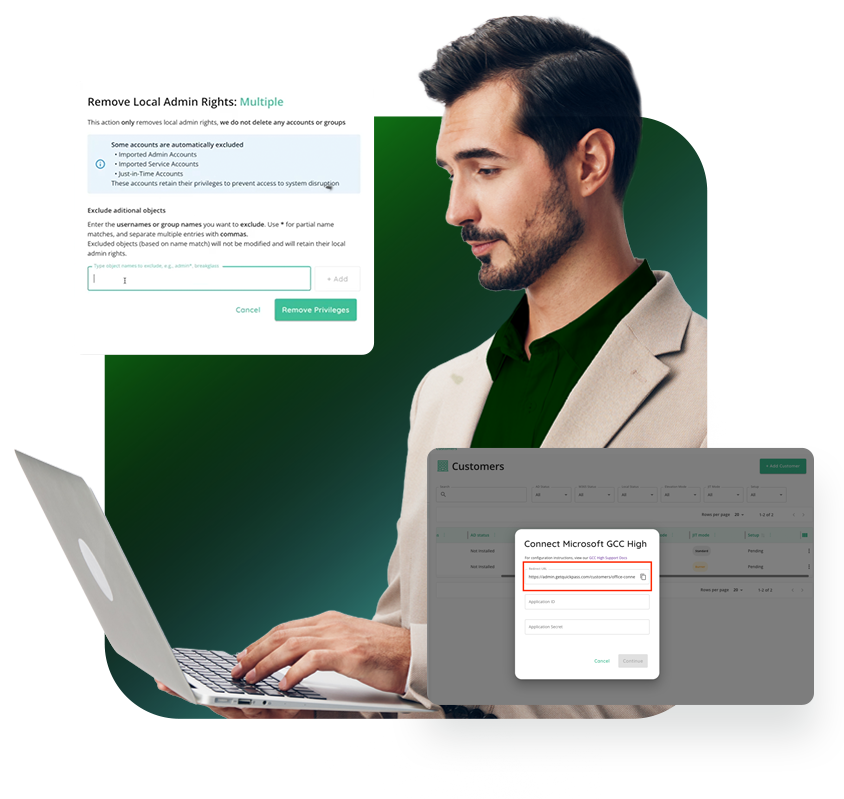
      Connecting a GCC High customer is straightforward, visit our KB Article for more in depth instructions.

      1. Navigate to the Customers page in the CyberQP dashboard
      2. Select the customer and click Connect GCC High in the actions button
      3. Follow the steps provided in the support documentation to create the GCC High Enterprise App for CyberQP
      4. Enter the Application ID and Application Secret from your GCC High tenant
      5. Click Continue to complete the connection

      Once connected, GCC High customers function exactly like standard M365 customers—full feature parity with no limitations.

      ISO 27001:2002 Product Control Mappings

      ISO 27001:2002 Product Control Mappings

      EBOOK

      ISO/IEC 27001:2022 CONTROL MAPPINGS

      See How CyberQP Aligns

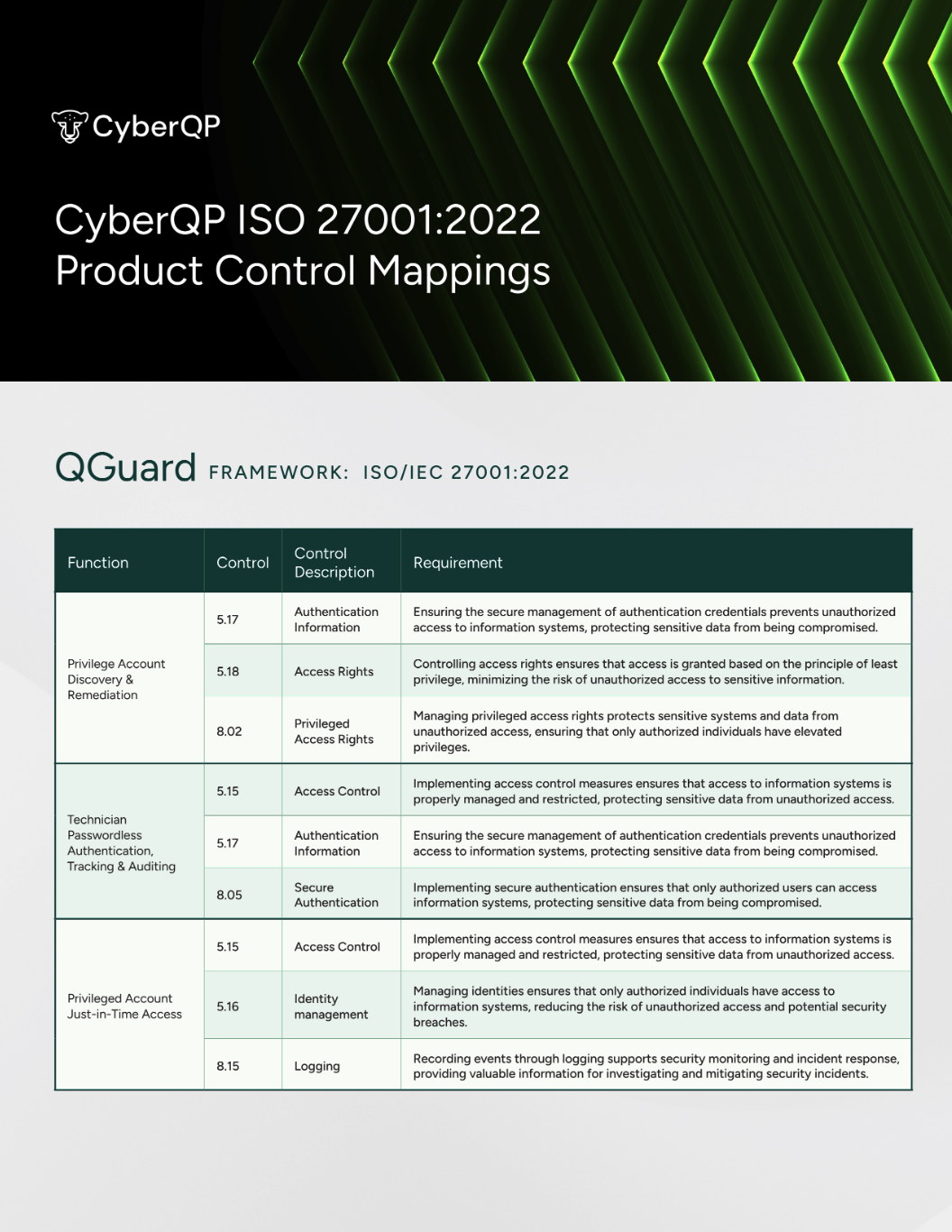
      Meeting ISO/IEC 27001 requirements around access control, authentication, and least privilege is challenging without the right tooling in place. This product control mapping shows how CyberQP’s solutions help IT teams reduce risk and produce clear audit evidence.

      MSP Incident Insights

      How CyberQP Supports ISO/IEC 27001:2022

      Privileged Account Just-in-Time (JIT) Access

      Controls: 5.16, 5.18, 8.02

      The Gap: ISO/IEC 27001 requires organizations to tightly control privileged access, enforce least privilege, and ensure that elevated access is granted only when necessary. Standing admin accounts and shared credentials increase the risk of unauthorized access and audit findings.

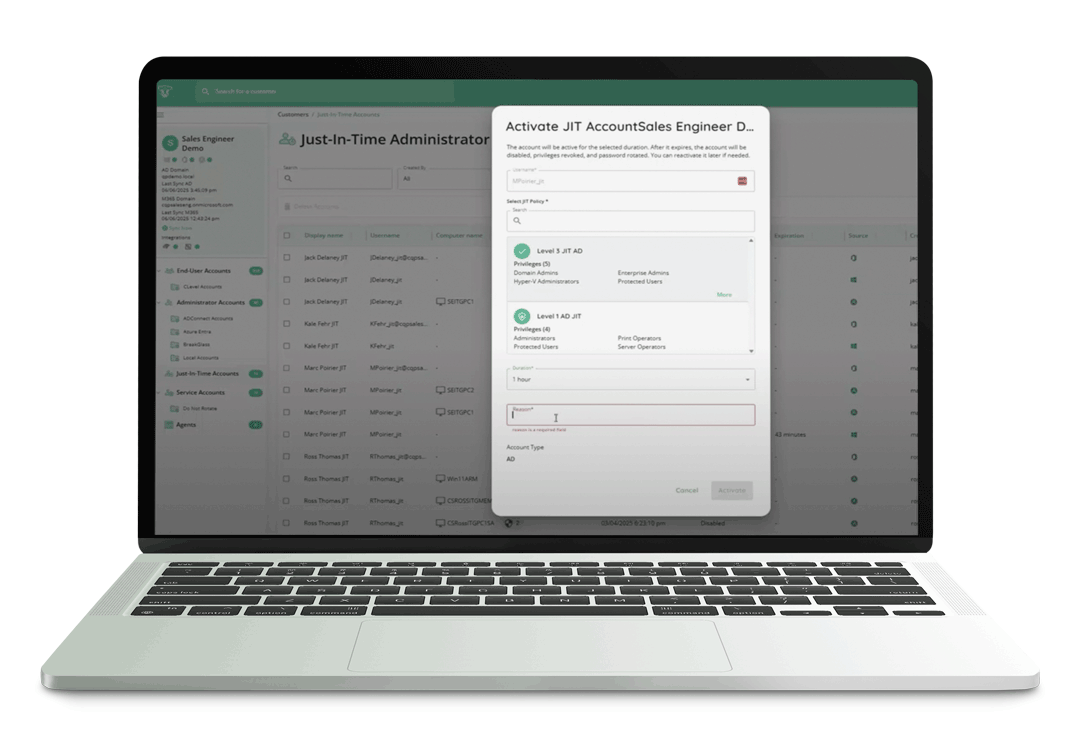
      CyberQP’s QGuard eliminates standing privileged access by issuing credentials only when needed through Just-in-Time (JIT) workflows. Access is time-bound, fully audited, and tied to individual technicians, reducing credential exposure while giving IT teams clear evidence of least-privilege enforcement during audits.

      Just in time access

      Passwordless Authentication, Identity Verification & Auditing

      Controls: 5.17, 8.05, 8.15

      The Gap: ISO/IEC 27001 emphasizes secure authentication, identity management, and activity logging. Password-based workflows and weak identity verification increase the risk of unauthorized access and make it harder to prove control effectiveness.

      CyberQP replaces password-based privileged workflows with passwordless authentication, strong identity verification, and comprehensive logging. Every access request, approval, and action is tracked and auditable, giving IT teams clear evidence of who accessed what, when, and why, without relying on shared credentials or insecure processes.

      Activate JIT

      Endpoint Privilege Management & Elevation Controls

      Controls: 5.15, 5.18, 8.02

      The Gap: Maintaining least privilege at the endpoint level is difficult without disrupting users. ISO/IEC 27001 requires organizations to limit privileged access while still enabling legitimate business tasks.

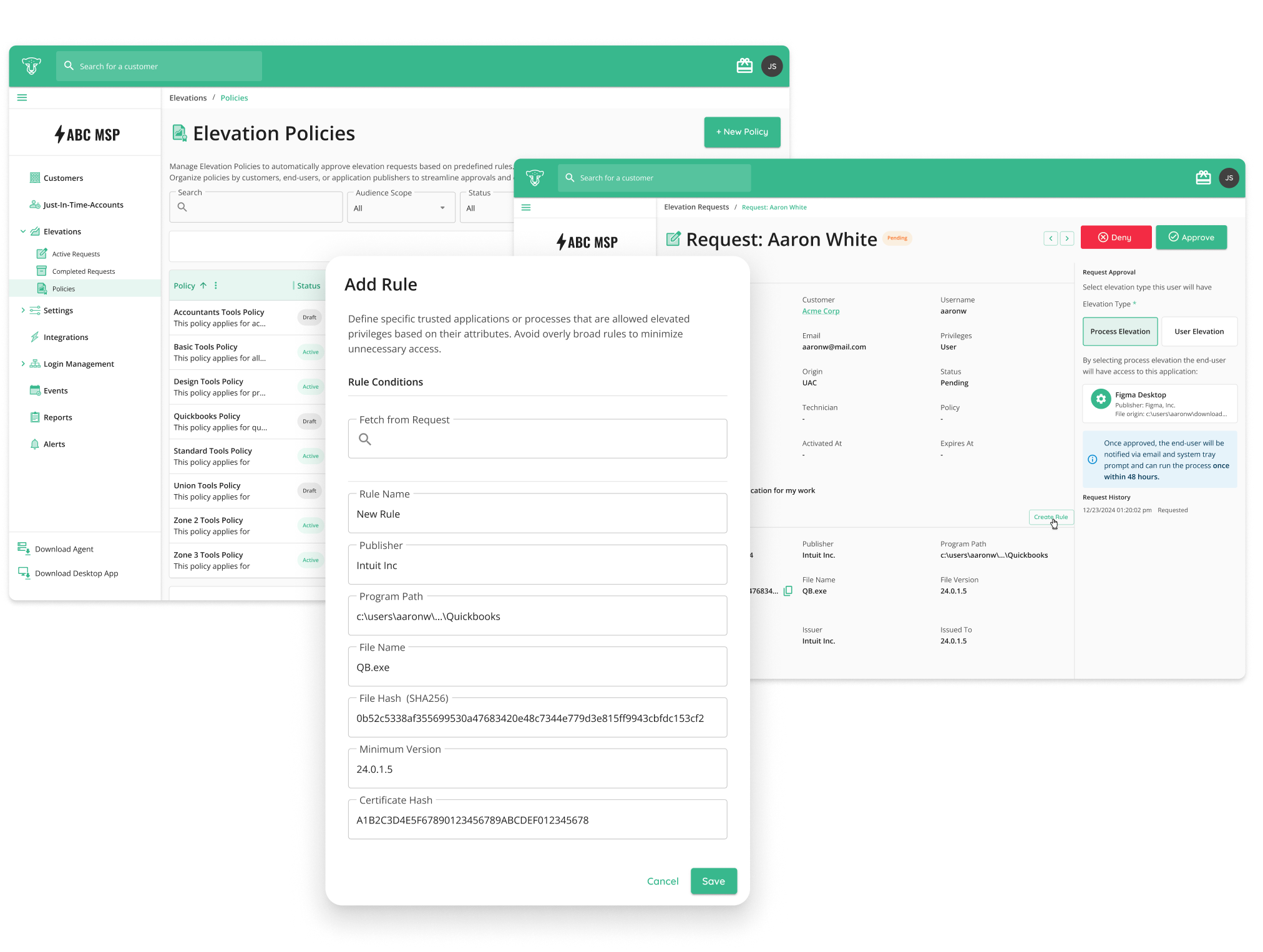
      CyberQP provides controlled elevation workflows, Audit Mode visibility, and policy-based approvals for applications and processes. IT teams can confidently remove local admin rights, approve only what’s necessary, and demonstrate controlled privilege escalation without increasing help desk volume or end-user friction.

      Password notifications
      MSP Incident Insights

      Download the ISO/IEC 27001:2022 Mappings and Prove Your Access Controls

        Supporting Microsoft GCC High Environments | CyberQP Product Release

        QTech Mobile App: End User Elevation Requests | CyberQP Product Release

        Manage Privileged Access Requests Anytime, Anywhere

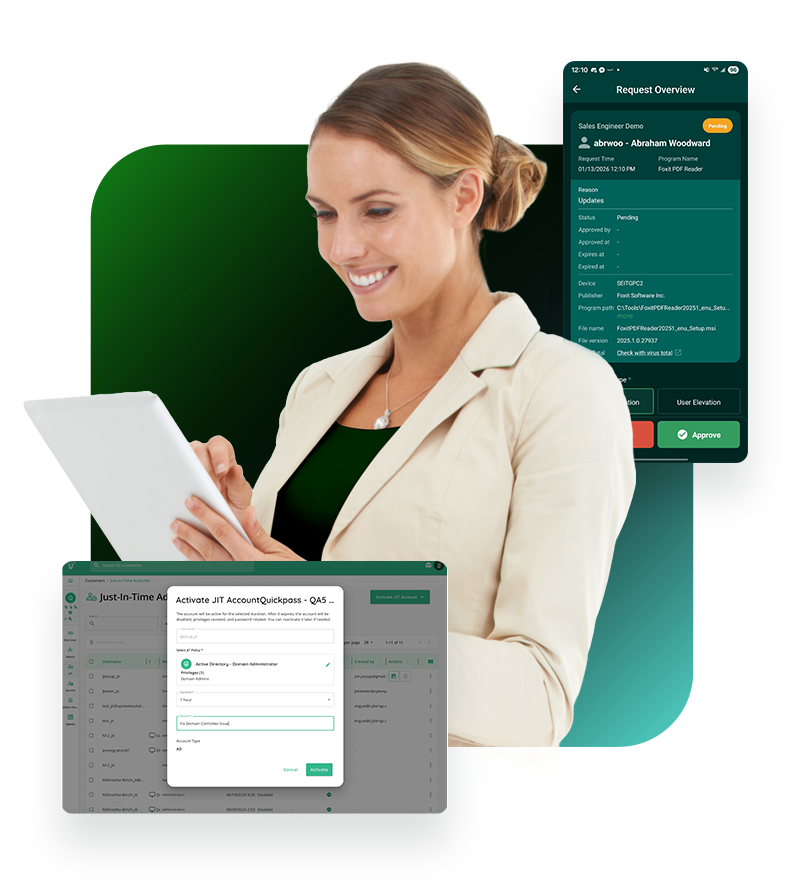
        We’re excited to announce a major enhancement that makes it easier than ever to manage privileged access while on the go. With this update, End User Elevation Requests can now be reviewed and managed directly within the CyberQP QTech mobile app, allowing admins and technicians to stay responsive even when they’re away from their desks.

        To address this challenge, we’re excited to introduce Local Admin & UAC Remediation, a new capability within CyberQP’s Agents Overview. This feature gives administrators instant visibility into endpoint privilege risk and the tools to remediate it quickly without scripts, RMM dependencies, or multi-step workflows.

        What Are End User Elevation Requests?

        End User Elevation Requests are requests submitted by end users on managed devices when they need to run an elevated process or require temporary admin rights to complete a task. These requests are sent to CyberQP, where a technician reviews the context and approves or denies the request before the user can proceed. This workflow enforces least-privilege security while giving end users a clear path to request access when needed.

        Why We Built This:

        Previously, managing End User Elevation Requests required technicians to log into the CyberQP dashboard from a computer. Quick approvals had to wait until someone was at their desk, creating delays for end users and friction for teams trying to enforce least-privilege policies at scale.

        The QTech mobile app previously only supported JIT account management and usage. Partners asked for a way to handle elevation requests on the go, and this release delivers that capability.

        With This Release, Admins & Techs Can:

        • Quickly search for elevation requests across organizations, users, and devices

        • Filter requests by status to easily locate pending or completed requests

        • Review request details to understand the context before taking action

        • Approve or deny elevation requests instantly, all from a mobile device

        The Result: Bringing elevation request management to the mobile app helps teams respond faster to end-user access needs, reduce delays during critical tasks, and maintain secure, least-privilege workflows. Whether handling urgent requests after hours or managing approvals during the workday, this update provides greater flexibility while ensuring privileged access remains controlled, auditable, and easy to manage from anywhere.

        CyberQP Looks Different

        CyberQP Looks Different

        A Lot Has Changed Since We Last Talked.

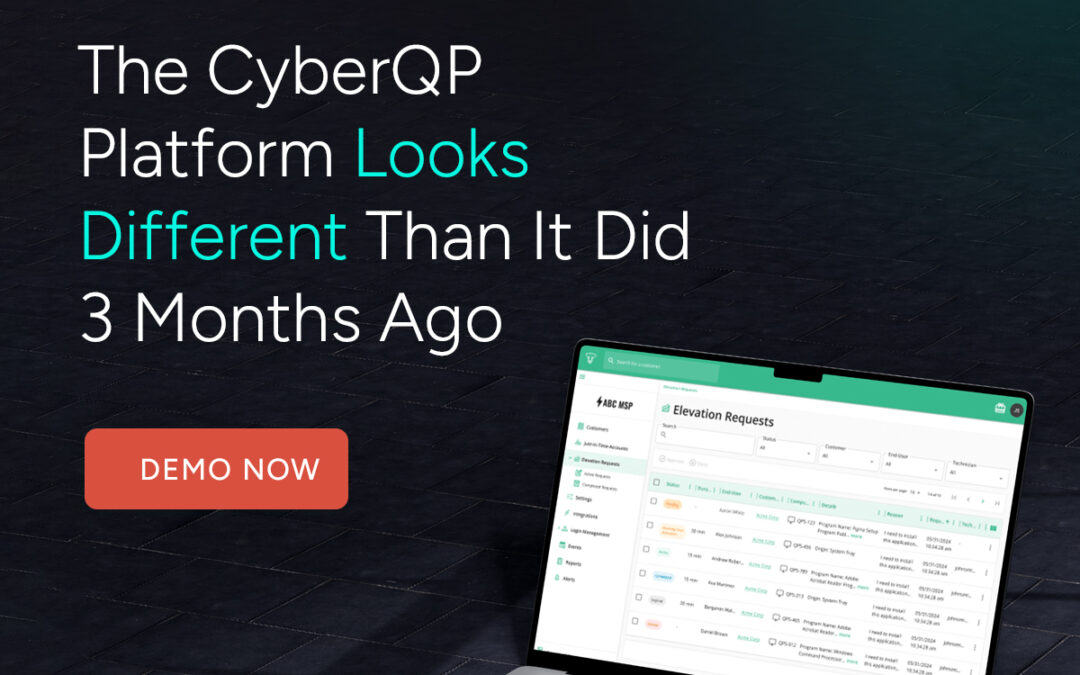
        Since we last spoke, CyberQP has evolved. New releases remove friction for techs, support high-compliance environments, and tighten control without slowing anyone down. Take a fresh look at what’s new, and see if CyberQP now fits the problems you’re solving today.

          What's New with QGuard?

          QGuard

          QTech Mobile End User Elevation Requests

          With this update, End User Elevation Requests can now be reviewed, approved, and managed directly within the CyberQP QTech mobile app which gives admins and technicians a faster way to stay responsive to user needs, even when they’re away from their desks or between customer sites.

          Watch Now →

          In Preview: Burner JIT Accounts & JIT TAP (Temporary Access Pass)

          Burner JIT Accounts extend traditional JIT access by fully removing the account from the target system once the access window expires. Unlike standard JIT accounts, which are suspended after expiration, burner accounts are automatically cleaned up, eliminating residual access and reducing identity sprawl.

          Download the Whitepaper →

          What's New with QDesk?

          QDesk

          *New* Duo for End-User Identity Verification

          CyberQP has expanded with a new identity verification option, Duo Security. This release enables MSPs and IT teams to standardize on Duo Push for end-user identity validation during support interactions, extending existing MFA processes directly into helpdesk workflows.

          Read the Blog →

          *New* Microsoft GCC High Support Now Available in CyberQP

          We’ve added support for Microsoft GCC High environments within CyberQP, unlocking privileged access management capabilities for partners who support GCC High customers.

          With this release, CyberQP can now securely integrate with Microsoft 365 GCC High tenants, enabling core privileged access workflows.

          Explore the KB →

          Audit Mode for Endpoint Privilege Management

           A powerful addition that allows IT Professionals to confidently move their customers away from standing local admin rights, without disrupting daily operations or user productivity.

          Audit Mode allows you to monitor and log every privileged application and process executed by end-users across your managed environments. This added visibility enables IT teams to identify legitimate business-critical tools and workflows in real time.

          Read our Blog →

          Local Admin & UAC Remediation (Agents Overview)

          A new capability within the Agents Overview that helps administrators quickly reduce endpoint risk and prepare environments for privileged access elevation.

          This feature gives clear visibility into which users have local administrator rights on each agented system and makes it easy to remove unnecessary privileges without relying on manual RMM scripts or multi-step workflows.

          Watch a Demo →

          partner stories

          See Why Our Parters Trust CyberQP

          Discover how help desks using CyberQP are securing their identity-based attack surfaces, eliminating standing privileges, and staying ahead of evolving threats. Experience the confidence that comes with a Zero Trust approach. 

          “CyberQP has helped bring a large amount of value to our clients, frees my techs to do more things, and keeps our customers — which [gives us] real peace of mind.”

          -John Douglas

          “It’s been phenomenal. Everyone was super helpful all the way through… I feel like they’re more invested in us than we’re invested in them.

          – RODDY BERGERON

          “[CyberQP] gives us the peace of mind knowing that we’re evolving, we’re rotating [privileged account passwords]…we’re making sure that things are different enough that we’ve reduced that potential attack surface.

          – RAFFI JAMGOTCHIAN

          “We’ve rolled out the agent to almost every managed customer. We implement password changes to uphold their agreement to their errors, omissions and professional liability policy.

          – MICHAEL GOLDSTEIN

          “We were looking for automation more than anything else in our security stack. CyberQP brought that to the table. They allowed us to automate admin password changes, rotate them, and know that we have that comfort.

          – ATUL BHAGAT